
Burnham’s trade union conundrum
A major headache for the new PM...

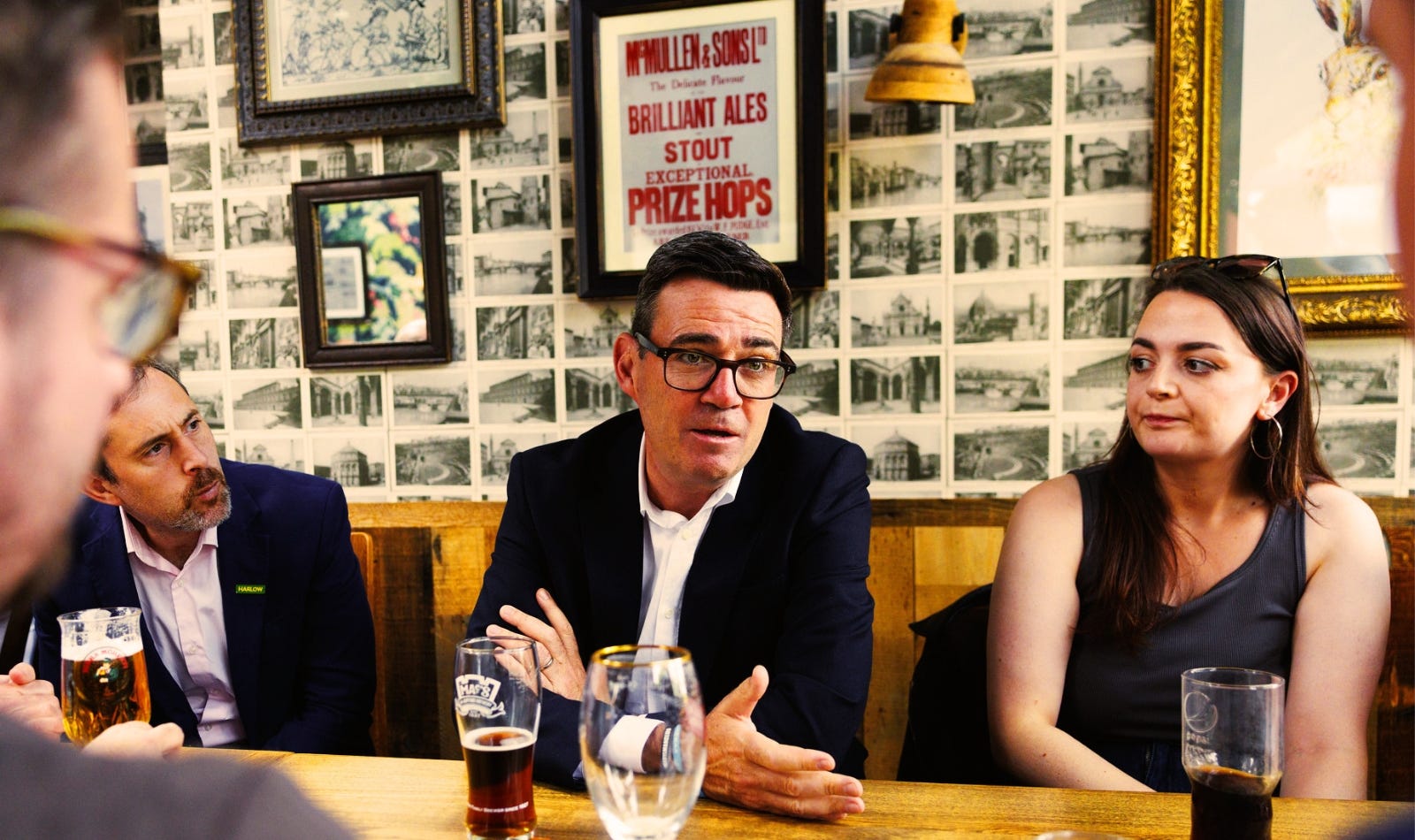
New prime minister Andy Burnham has been on a policy rampage in his first fortnight, galvanising progressives behind his leadership and pushing Labour above Reform in the polls for the first time in years.
As I’ll probably write in more detail in a future article, this effort is fundamental to Burnham’s chances of winning a general election. Polls show that Green voters are more likely to back Labour than Reform supporters, and Labour’s recent revival is correlated closely with the declining popularity of Zack Polanski’s party.
You may think that’s a shame, but the electoral fact is that two left-wing parties with 15% of the vote is worse – at least if we want to stop Reform – than one party with 30% of the vote.
Keir Starmer was booted out of Downing Street because Labour was battered in May’s elections – an outcome caused in large part by progressive apathy. Swathes of people who voted Labour in 2024 stayed at home or switched their vote, while diehard Farage fans flocked to the polling station.
Burnham needs to send those trends catapulting into reverse if he stands any hope of retaining power – and, judging by his first couple of weeks, he possesses the charm and zeal glaringly absent from Starmer’s administration.
However, one story has been casting a shadow on this new, resurgent Labour government. Namely, Burnham has suggested – including on Thursday – that he will approve new oil and gas drilling in the North Sea.
As plenty of experts have shown, the North Sea is a declining basin (i.e. we’ve drilled virtually all there is to drill) and, with fossil fuels generally traded on the international market, ramping up production will muster some tax receipts but will do virtually nothing to reduce customer bills.
Some have claimed Burnham is considering this policy because he’s in hock to “corporate lobbyists”, but that couldn’t be further from the truth (sorry, Cody Dahler).
In reality, Burnham is responding to pressure from the trade union movement, which has close ties to his government. His key ally Louise Haigh is steeped in the union cause, and was a shop steward for parliamentary staff at Unite the union.
Trade unions represent the oil and gas workers who stand to lose their jobs if we close down the sector (assuming they can’t be redeployed into the clean energy industry). Therefore, some unions have taken a particularly aggressive line – notably GMB – in opposing net zero policies.
Add in Burnham’s ideological war with the 1980s – the decade that decimated the UK’s coal industry – and the reasons for his fossil fuel leniency become obvious.
However, that doesn’t put Labour on the same side as progressive voters. According to a new Survation poll of 10,000 people, two-thirds of Lib Dem and Green voters, and 59% of Labour voters, are now more fearful of climate change than previously, due to the extreme heat raging across the UK and Europe.
Long sweaty nights, wildfires, and “exceptionally serious” droughts tend to open people’s eyes to the climate crisis, and progressive voters are hardening on this issue – not the other way around.
If Burnham announces pro-oil policies – especially during a heatwave – he risks losing all the ground gained among left-wing voters during his first fortnight.
What’s more, Burnham’s affinity with the unions risks kiboshing another crucial policy demanded by progressives: regulating our political finance system so one billionaire crypto baron can’t buy our democracy.
As The Guardian reported a few weeks ago, GMB wrote to its affiliated MPs urging them not to demand the government introduce a cap on the amount that any one individual can donate to a political party in a single year.
The newspaper reported that GMB and other Labour-affiliated unions were concerned that a cap would endanger trade union funding of, and influence over, the party.
So, the trade union movement – the vanguard of redistributive change in modern Britain – is now acting as a conservative force on two vital policy issues.
In a desperate attempt to preserve their political clout, the unions seem willing to preserve the influence of corporate predators who bankroll reactionary parties and their attempts to smash workers’ rights.
And, by lobbying for new oil and gas production, they’re helping to unleash climate change on the vulnerable communities that are on the frontline of this ever-unfolding disaster.
It’s entirely natural and understandable for a Labour leader to ally with the trade union movement, one of the pillars of progressive politics.
However, when some of those unions support policies that would prevent us from cleaning up our democracy and planet, I would be keeping them at arm’s length – especially when progressive voters, who will decide your political fate, are feverishly watching your every move.
About me
I investigate the rich, populist and powerful – focused on Nigel Farage and his cronies. I’ve written for the likes of the New York Times, The Guardian, and New Statesman, have worked with Led By Donkeys, and have written two books on elitism and inequality.


“I just subscribed this week. Best 30 quid I’ve spent this year. Loving your work.”
– Mrs M, paid subscriber
“I like reading your stuff, you write well, easy to read – it’s brief, to the point, and oh what great points. I’d like to do my little bit to help keep you in business. Plus anything to annoy Nige!”
Thanks Sam - that explains a lot.
I read recently that Mark Carney has explained to his fellow Canadians that whilst he wishes to build up the Green energy sector to completely replace fossil fuels, the sector is not yet ready and therefore Canada must continue to utilise fossil fuels in order to fund the expansion of greener energy and meet the shortfall.
As a strategy it works to get to the end point.
If AB could embrace this strategy and explain it as such. Could that keep everyone happy I wonder?