
Farage’s foreign web: MAGA and UAE
🇺🇸 Part 2 🇦🇪

This investigation was funded by my paid subscribers and donors, who have been incredibly generous in supporting my work. If you’d like to contribute to more stories like this – and join a community fighting back against Farage – sign up today.
This investigation is split into two parts – the first of which should already be in your inbox. If you’d prefer to read it all in one article, hit the link below.
MAGA
“I am also cognisant of a potential new threat: an emerging willingness of foreign actors and private citizens, including from allies like the United States, to interfere in, and influence, politics abroad in pursuit of their own agenda.”
– Philip Rycroft, the Rycroft Review, March 2026
Of course Viktor Orbán will never be Farage’s favourite autocrat – a title that will forever be held by Donald Trump.
While much of Europe sees Trump as a trigger-happy tyrant with a God complex and a toxic thirst for fame, to Farage he offers a political model to emulate.
Farage was the first foreign leader granted an audience with president-elect Trump in the wake of the 2016 election, and Farage may well have seen his own future reflected in the gaudy gold panels of the Trump Tower elevator.
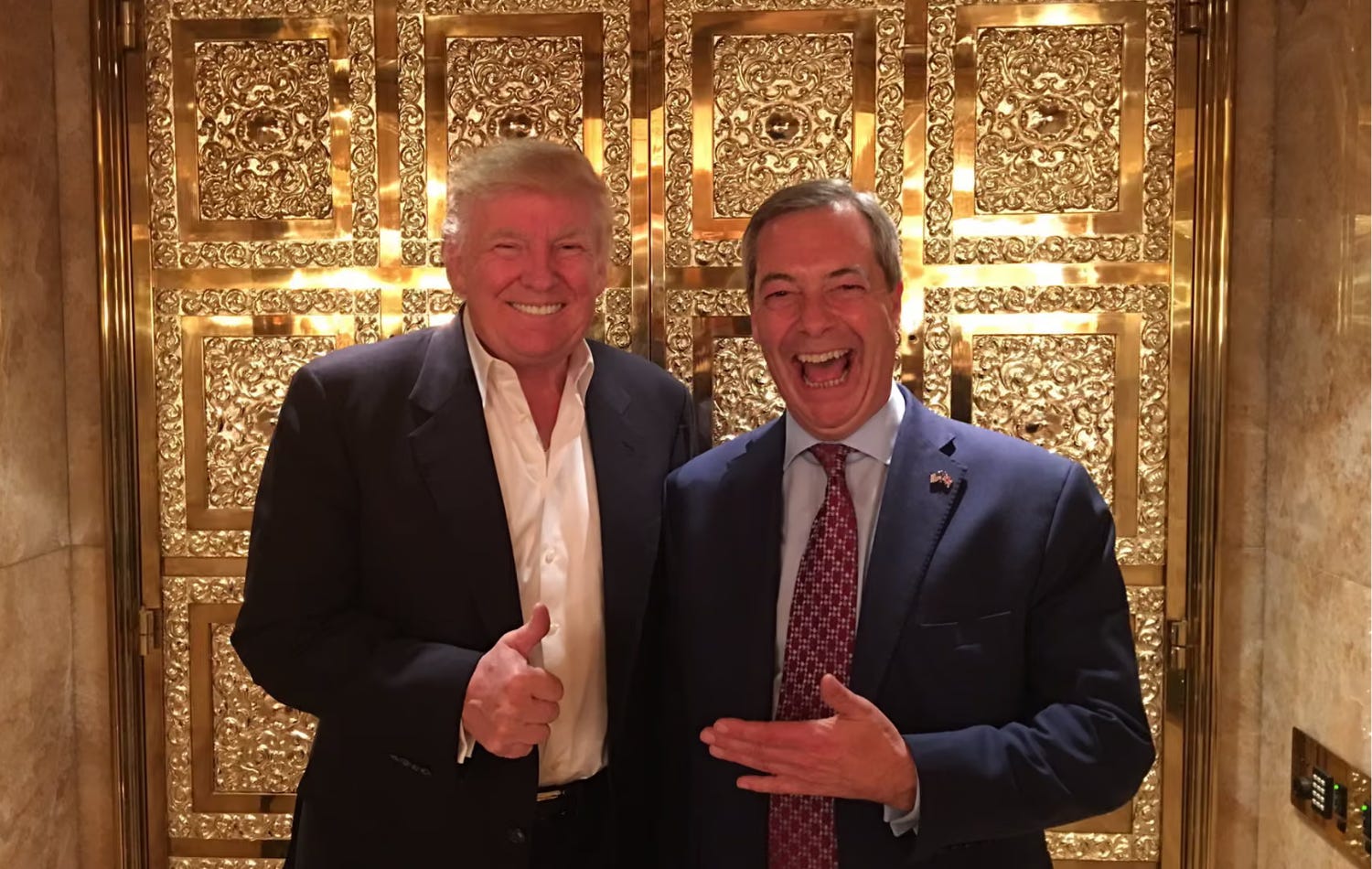
Farage is a MAGA politician operating on British shores. To all intents and purposes, he is an agent of Trump’s regime trying to transport his agenda from Washington to Westminster.
The reasons for Farage’s America-obsession are multi-faceted. Some are ideological, and some are purely financial.
The showmanship of American politics also appeals to Farage. U.S. elections are gruesome spectacles of ego, money, and emotion. Corporate-funded attack adverts harangue voters and appeal to their worst instincts. Politicians are celebrities rewarded for sensationalism over substance.
This is Farage’s mode of politics. He’s bored by Britain’s village politics – potholes, planning meetings and parish disputes – one of the reasons why he’s rarely seen in his local constituency. On the few occasions that he does press the flesh with the general public, he’s almost always pictured with a pint in hand. My theory is that drinking is the only way he can stomach interacting with ordinary people.
As his close ally Raheem Kassam told the New Statesman in December: “If England were the 51st state, Nigel Farage would be one of the senators.”
In this spirit, Reform’s annual conferences are more akin to MAGA rallies than the modest, humdrum affairs staged by other parties. Farage and his clan walk out on stage to turquoise fireworks as they try to put the assembled masses into a hypnotic trance through strobe lights and anti-immigrant diatribes.
Reform mayor Andrea Jenkyns may have let the razzle-dazzle get to her head, however, when she warbled a self-penned song – Insomniac – on stage at last year’s jamboree.
Like a fly buzzing around a chandelier, Farage is instinctively drawn to America’s pyrotechnic politics.
But Farage also adores the United States for another reason: money.
The country’s reverence of wealth, and its status as the frontier of “free market” capitalism, corresponds with Farage’s Thatcherite creed. As he told the New Statesman: “If someone’s made a fortune [in America], everyone goes: ‘Oh, fantastic, well done, mate.’ In the UK they all look at you sideways.”
The U.S. speaks to Farage culturally, politically, and financially. He wants to smoke fags, drink beer and make money without bureaucratic interference. He’s a libertarian – which is one of the reasons he appeals to the rebellious, contrarian instincts of the British working classes, who regard authority with suspicion.
Farage’s foundational political project, Brexit, was therefore never about taking back control or – as some have suggested – returning Britain to the politics of the 1950s. For Farage and his disciples, it was about emulating America – turning Britain into Texas-on-Thames.
Farage is an ideological conduit for MAGA – channeling its predispositions and personnel into the British political bloodstream.
And his relationship with Heartland Institute is an instructive example.
A little over a year ago, on 17 December 2024, Farage delivered a speech on home turf – a private members’ club in Mayfair, London.
The Reform leader was addressing the UK launch of the Heartland Institute, a Chicago-based, pro-Trump organisation.
Masquerading as a think tank, the Heartland Institute casts doubt on the evidence for man-made climate change, berates prominent scientists who warn of its effects, and lobbies for fossil fuel-friendly policies.
Its influence is epitomised by the fact that, when Trump announced in June 2017 that he was withdrawing the U.S. from the Paris climate agreement, Heartland’s CEO was in the front row.
Over the past 18 months or so – thanks to the help of Nigel Farage – the group has been extending its tentacles into the UK and Europe.
A pivotal moment came in September 2024, when Farage addressed the Heartland Institute’s 40th anniversary fundraiser in Chicago (alongside a far-right Austrian politician).
During his speech, Farage urged the group to set up a new satellite across the Atlantic.
“Give us your wisdom, give us your guidance, give us your discipline. I’d love to see Heartland on the other side of the pond,” he said.
Lo and behold, just a few months later, Heartland set up shop in London – its UK-EU office led by Lois Perry: a Reform supporter and a close ally of Farage who, like him, is a former leader of UKIP.
Heartland is actively advising Reform on its energy and climate policies, and hosted a keynote panel at the party’s annual conference last September.
Using London as a launchpad and Farage as a proxy, the Heartland Institute has been trying to interfere in politics throughout Europe. As I’ve documented for DeSmog and The Guardian, the group has been attempting to use far-right politicians to immobilise the EU’s clean energy agenda.
And Farage’s Heartland liaison isn’t a one-off. The Reform leader has quietly been accepting advice from a number of groups that forged Trump’s second term agenda. And what begins as “advice” has a habit of becoming doctrine.
This includes the Heritage Foundation – MAGA’s policy bureau – which convened Project 2025, the blueprint for Trump’s authoritarian, pro-oil, pro-tech, anti-abortion exploits.
According to The Spectator – which under Paul Marshall’s stewardship is rapidly becoming Reform’s in-house magazine – key figures behind Project 2025 have been “shuttling between London and Washington” to bestow their wisdom on Farage.
Nile Gardiner, director of the Heritage Foundation’s “Thatcher Centre”, is a key node in this transatlantic Trumpism, reportedly acting as a bridge between the White House and Reform.
Trump offends almost every fibre of the average Brit. Even before the energy price spike provoked by his war with Iran, a massive 81% of us had an unfavourable opinion of the U.S. president.
This also goes for his agenda, which is broadly shared by Farage. Only a minority of Brits have been captured by MAGA’s conspiratorial, nativist, grievance politics. There may be a stubborn conservative streak among UK voters, including an unsettling inclination to blame immigrants for all the country’s problems, but generally we’re trusting of science, are tolerant of diversity, and want to preserve our public services.
To put it another way, as Tim Stanley of The Telegraph recently said, “I would prefer to be a welfare state than some kind of free trade zone with a military attached” – a reference to Farage’s desired end goal.
Farage claims to be a patriot, yet his political project – and his loyalty to Trump’s America – contravenes the values held even by ardent conservatives like Stanley.
Take Farage’s association with the Alliance Defending Freedom (ADF). One of the co-authors of Project 2025, the ADF is a powerful anti-abortion advocacy group that successfully led the campaign to overturn Roe v. Wade – the constitutional right to an abortion.
Farage’s ties to the group have been multiplying in recent years. In September last year, he testified in Congress against his own country’s free speech rules, making spurious claims about the UK government’s approach to online censorship. The ADF orchestrated Farage’s appearance, brokered meetings between the Trump administration and Reform, and has reportedly supplied the U.S. government with attack lines that portray the UK as hostile to free speech.
During his 31-year career, Farage has basically been silent on abortion – likely reflecting the fact that it’s an uncontested subject among British voters. However, following his entanglement with the ADF, the Reform leader has been taking an increasingly anti-abortion stance, claiming last May that the 24 week limit in the UK is “utterly ludicrous”.
Farage may not have started as an anti-abortion campaigner – but he is increasingly comfortable standing alongside those who are.
Farage’s acquiescence to Trump’s agenda – his fealty to the MAGA brand – was perhaps best expressed in February 2025, when he gave an address to CPAC, the annual pro-Trump gala.
Farage said that the U.S. was at the “beginning of a golden age” – as opposed to the UK, where “you can’t say anything or you might get put in prison”.
He echoed conspiracy theories about Covid vaccinations and the 2020 presidential race being “stolen”.
“Remember in November 2020, you couldn’t say anything about the conduct of the election in this country, you couldn’t say anything about vaccines or lockdowns, without social media closing you down,” he said – adding: “the Trump win [in 2024] has the ability not just to save your country – not just to make you freer and more prosperous than America has ever been… but it’s also producing a wave that is now coming the other way across the Atlantic.”
Farage went on: “In fact, in many ways what we’re fighting for is a very similar agenda to the one you’ve just fought for, and the one you have succeeded with.”
Incidentally, Farage didn’t make an appearance at CPAC this year – marking his first absence in three years – possibly because Trump’s victory has sent a wave of economic bedlam tumbling across the globe, rather than the freedom and prosperity predicted by Farage.
As the price of everything rockets upwards thanks to the Iran war, a conflict backed by Farage, his devotion to MAGA over the UK – and his betrayal of our national interest – is becoming fatally apparent to voters.
If you’d like to support more stories like this – and join a community fighting back against Farage – sign up today.
UAE
One of Reform’s strangest foreign alliances has been with the UAE – an Arab Muslim dictatorship partly governed by Sharia law in which nearly 90% of the population are migrants.
By contrast, Reform has an anti-Muslim, anti-immigration agenda – an awkward contradiction that has been strangely ignored by the party’s senior figures as they eulogise the UAE at every opportunity.
As part of his trip to Dubai in February for the GB News party, Farage conducted a sycophantic interview with UAE minister Reem Al Hashimy, during which he claimed that “on law and order, there’s a bit we can learn back in the United Kingdom” from the UAE.
Just a few weeks later, in late March, it was reported that 70 Brits had been arrested in the country for the mortal offence of taking photos during Iran’s bombardment of the country – an example of the UAE’s brutal approach to “law and order”.
And yet, the UAE is another country Reform politicians prefer to the UK.
In an interview with Arabian Business in October, Farage’s deputy Richard Tice praised the UAE for its sense of national pride, work ethic, law and order, integration of migrants, and energy sector, while claiming that the UK is “decadent” and “going bust”.
He failed to mention that migrant workers face “widespread abuses” in the UAE, according to Human Rights Watch, including wage theft and passport confiscation. Tice also told the BBC that the UK’s “basic values” are “not working”, when asked why he speaks so favourably about the UAE.
But Tice’s grovelling somehow pales in comparison to the cringing obsequiousness of Reform treasurer Nick Candy.
Displaying all his geopolitical nous, Candy claimed in a January 2025 article that: “Wealth mobility has reshaped the way the global elite think about where to live, work and invest – and all signs point to the Middle East, particularly Dubai and Abu Dhabi, as the new frontier.
“Having invested in the UAE’s thriving property market, I see this as just the beginning of the Emirates’ transformation into a global epicentre for success.”
Candy evidently didn’t consult the Iranian Revolutionary Guard before penning this particular piece.
And his fawning didn’t stop there.
He praised the UAE’s crime prevention and “robust law enforcement”, adding: “Coupled with a high standard of living, excellent healthcare and top-tier schools, the UAE offers a lifestyle that few other locations can match.”
Few war-zones can compete, I’ve heard.
Candy also lauded “the wisdom and visionary nature of the UAE’s leadership”, writing that “the quality of government officials is mind-blowing”.
By contrast, he said that Western countries are ruled by “second-tier individuals” who “allow political agendas to get in the way of what is best for the country” – a sentence that looks an awful lot like an endorsement of authoritarianism.
Why has Reform clustered around this far-flung Arabian dictatorship?
There are several reasons, and Candy provides a good example of the first.
Namely, he has a financial interest in the country. In October 2024, his firm Candy Capital entered into a “strategic joint venture partnership” with Modon Holding – a real estate company owned by the Abu Dhabi government – while he has also partnered with the state-owned Dubai World Trade Centre to develop “super-prime” properties on the site.
Or at least that was before Iran cooked the Dubai property market.
Tice has his own interests in the UAE, but in different ways. As I mentioned earlier, his partner, Telegraph journalist Isabel Oakeshott, moved to Dubai in January 2025 as a self-described “tax exile” from the UK.
Meanwhile, recent Reform recruit Nadhim Zahawi is a senior figure at Omniyat, a luxury property developer in Dubai that racked up $800.2 million (£583 million) in sales a couple of years ago.
When announcing Zahawi’s defection from the Conservatives, Farage said he hoped the former Tory minister could raise “huge amounts of money” for Reform.
And, at least until recently, Farage hoped some of that money would be channelled through the UAE.
During his jaunt to Dubai in February, the Reform leader gathered a gaggle of local residents – those who have fled the UK – and encouraged them to give a portion of their tax-free earnings to Reform. Farage was reportedly seeking to exploit a loophole that allows foreign residents to donate to UK political parties via a British-based private company.
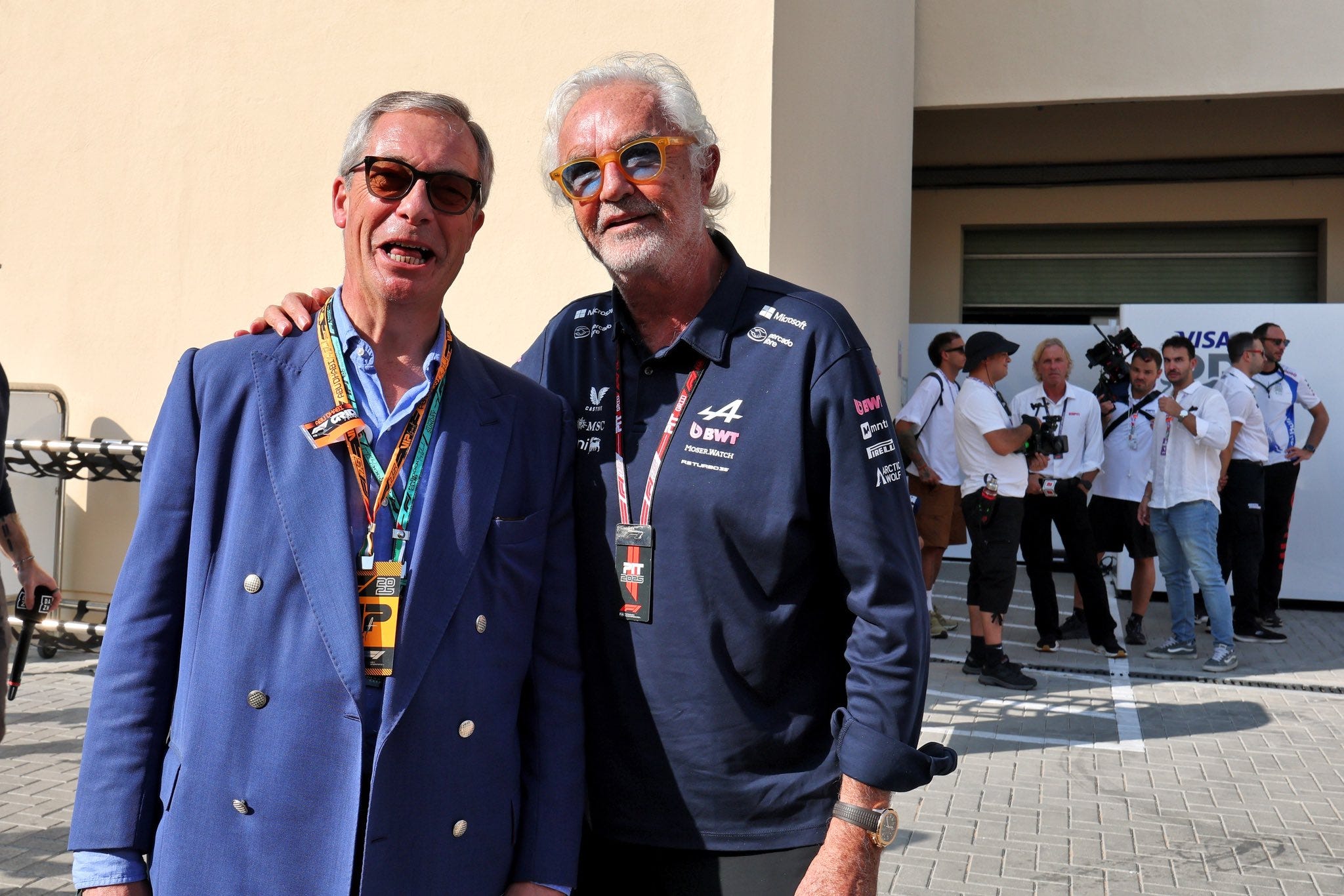
And then we come to Farage himself, who received accommodation and front-row tickets worth £10,000 in December from the Abu Dhabi government – a trip that involved meetings with UAE ministers. If there are snouts in the trough, you can always bet that Farage’s will be one of them.
I’m just speculating, but these financial considerations may well explain the remarkable speed at which Farage has changed his views towards the UAE.
The Reform leader is often branded as a “conviction” politician who stands true to his “principles” while others flail around like ideological weather-vanes. However, Farage has indicated that his so-called convictions – including his attitudes towards foreign regimes – can easily be swayed by wads of cash.
For example, writing for The Telegraph (one of his many employers) in December 2023, Farage said he was “deeply uncomfortable about the possibility” of the UAE taking over the newspaper, as was being negotiated at the time.
He described the Gulf state as an “absolute monarchy with an abysmal human rights record” and said it “seems fanciful that it would take jokes or questions in the spirit that runs through the British press”.
Yet, now, after a couple of glitzy trips to Dubai and some lobbying from local politicians, Farage appears ready to flog not just a newspaper but our entire country to the Gulf.
That said, in many ways it’s unsurprising that Farage has experienced a Damascene conversion on Dubai. After all, the place knits together all the features that define his foreign alliances.
It’s an authoritarian-libertarian fever dream: an offshore tax haven, an oil dictatorship, a money laundering paradise, and a backdrop for manosphere influencers.
This is the sort of society that Farage wants to bring to the UK. To me, and most Brits, it’s totally alien to our values. But that’s because Farage is not a patriot. He dislikes Britain. He wants to whitewash our identity and inscribe a new national culture modelled on his favourite gaudy, corrupt, venal foreign regimes.
Farage is in the pocket of foreign interests – and he’s perfectly happy about it – because he purposefully put himself there.
Really excellent article ,well done.I think more and more people are seeing through Nigel Garbage (to use an Americanism).More strength to your pen.
Gosh! Excellent article. Thank you.