
Farage’s Tory recycling scheme
And why it will surely backfire...

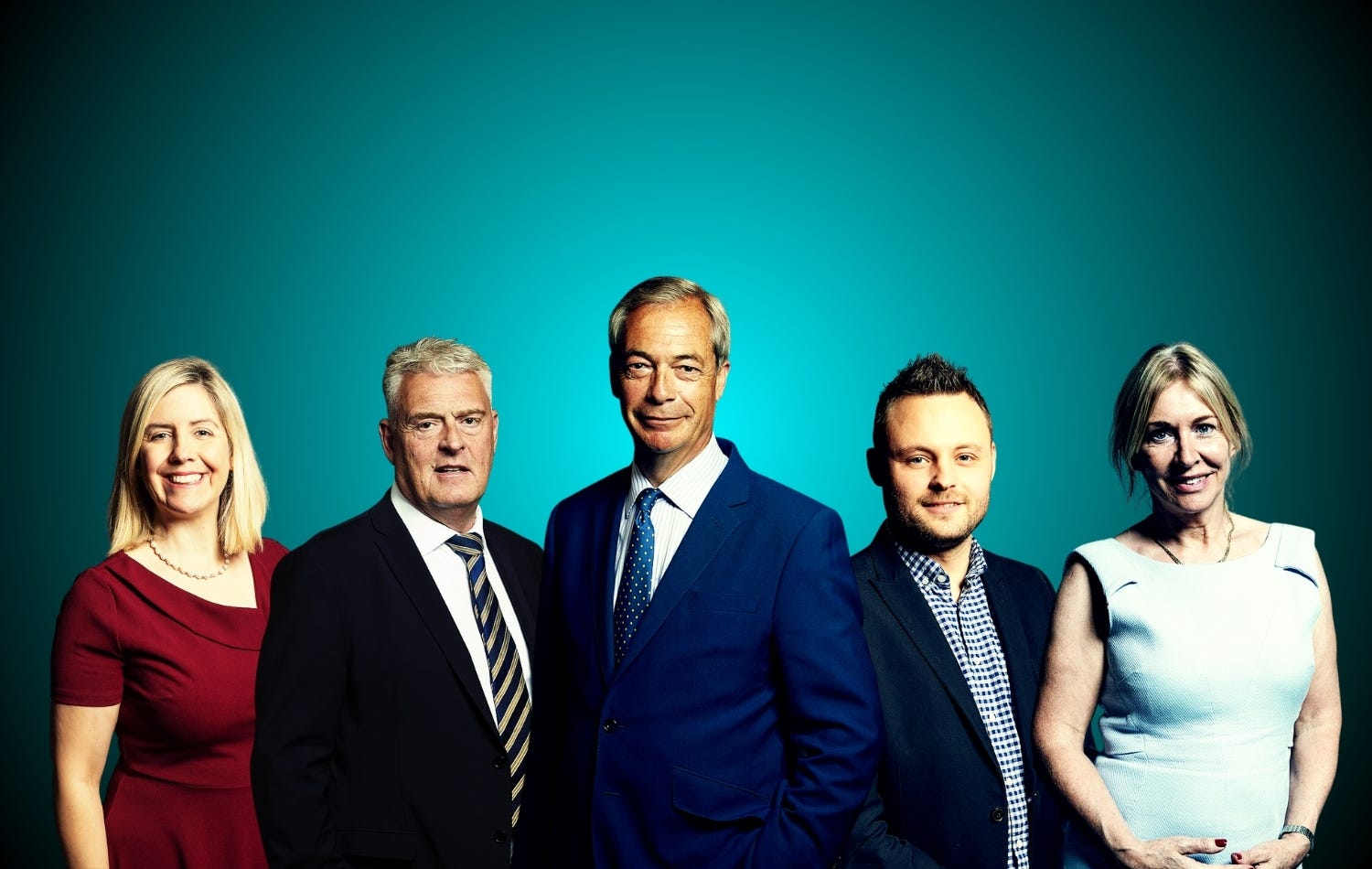
Nigel Farage is doing something he’s never done before.
He’s attempting to build a serious political party with branches, processes, and a pipeline for “talent” to rise through the ranks.
For opponents of Reform, this presents a risk and an opportunity.
The risk is that Farage’s project will be far more durable if he succeeds. He’s trying to create a multi-headed hydra whereby the body survives even if one head is decapitated.
But Farage’s inexperience presents an opportunity. Throughout his career, he has churned and burned through allies. There is a political graveyard full of people who once worshipped at Nigel’s altar only to realise that he has no loyalty to his disciples.
Creating a resilient political movement is an uncomfortable process for a man who has operated for so long as a lone ranger.
Even so, Farage has talked bombastically about the recruitment drive augmenting Reform’s political evolution.
He has played on people’s justifiable frustration with Oxford-educated political careerists running the country – promising instead that his administration would recruit ministers with lived experience in the sectors they govern.
However, few have asked the question: how well is he doing so far?
In my view, his recruitment drive has been a disaster; the wider public simply hasn’t realised it yet.
The evidence over the past 18 months or so indicates that Farage has only been successful in mining from the dregs of the Conservative Party – hiring certified has-beens who should be confined to the dustbin of political history.
This has been the case for some time. One of Reform’s first recruits was former Tory MP Lee Anderson – a relic who pines for a past in which the coal mines were open and sexist puns reverberated throughout the House of Commons.
Even before he was elected as a Conservative MP, Anderson had a record of doing and saying stupid stuff, so Farage can’t claim ignorance.
During the 2019 election, Anderson was caught asking a friend to pose as an anti-Labour voter for a documentary, and said on Facebook that “nuisance” council house tenants should be forced to live in tents and pick vegetables as a form of “forced labour”.
Somehow, though, Anderson isn’t even Reform’s worst signing.
Since then, Farage has added a bunch of former Tories to his ranks, none of whom have glittering CVs:
Danny Kruger, a former Tory MP who’s leading Reform’s preparations for government, wants more restrictive abortion laws, and has claimed that marriages between men and women are “the only possible basis for a safe and successful society”.
James Orr, a senior advisor to Reform, has claimed that Russia’s war in Ukraine is a “regional Slavic conflict” that he doesn’t “care much about”. Orr doesn’t think abortion should be allowed at any stage of foetal development, including pregnancies resulting from rape.
Ben Bradley, a former Tory MP now helping to run Reform’s local ‘DOGE’ unit, has previously suggested that free school meal vouchers are funding “crack dens”, and that poor men should have vasectomies if they can’t afford children.
Andrea Jenkyns, a former Tory MP now serving as Reform’s Greater Lincolnshire Mayor, has said she doesn’t believe in climate change. She also raised her middle finger to protestors outside Downing Street during Boris Johnson’s premiership, and stormed out of a Sky News interview after saying that asylum seekers should be housed in tents.
Sarah Pochin, a former Tory councillor and current Reform MP, caused a stir in June for suggesting that the UK should ban the burka – a comment that Reform’s own chair Zia Yusuf called “dumb”.
Jonathan Gullis, former Tory MP and party deputy chair, has called striking teachers “commies”, and labelled some of his own constituents as “scumbags”.
Nadine Dorries, former Tory MP (and Boris Johnson super-fan), infamously accused the BBC of being nepotistic, despite the fact she employed her own daughters. She also accused LBC’s James O’Brien of being a “public school posh boy f*** wit”, while sending her own children to the same school that he attended. She also had no idea how Channel 4 was funded, even while serving as secretary of state for digital, culture, media and sport.

Farage has built a safe house for these disgraced Conservatives because he wants to encourage the perception that Reform is the only viable right-wing party in Britain right now. If Farage wants to maximise his vote share – and his party’s income – he needs to annihilate the Tories.
Yet, there’s surely a limit to this strategy.
Eventually, Reform will resemble the party booted out of office at the last election. Farage’s promise of a revolution will be ring hollow if he continues to recruit former members of failed Tory administrations who are desperately trying to regain political relevance.
We may have to wait for the next election campaign for these facts to dawn on voters. People are not paying close attention to day-to-day political developments, so don’t realise that Reform has become a sanctuary for newly-unemployed Tories.
However, this post-election political apathy is potentially lulling Farage into a false sense of security.
Namely, he has welcomed a litany of former Tories – baggage and all – while still comfortably maintaining his lead in the polls.
He’s suffered few, if any, repercussions – incentivising him to carry on absorbing ghosts of the political past.
This may come to bite him on the backside, though, when the stakes are higher, an election looms nearer, and people start to question why Farage has granted refuge to an army of idiots whose political ambition far outweighs their cumulative talent.
As I’ve written before, Farage’s position is more fragile than it seems – and his political weaknesses will become more and more obvious as we march towards the next election.
For now, we have to stay patient, keep on collecting the receipts, and – I would recommend – have an extra glass of mulled wine to fortify us for the fight ahead.
Subscribe for free – or take out a paid subscription and help me to continue investigating Farage and Reform in 2026…

There is one VERY big problem...the naivety of the electorate.
Reform are gaining support from former Tory and Labour voters - https://www.markpack.org.uk/174682/council-by-election-results-scorecard-2025-2026 - the other parties must form electoral pacts.
James Orr is also in cahoots with JDVance and Project 25. I question his position teaching at Cambridge - what is he teaching young undergrads?