

Riots are consuming France, again.
In time-honoured tradition, protests have erupted in schools across the country. Students are demanding better classroom conditions, and in many cases are razing those very classrooms in order to grab the government’s attention.
Yet I reckon these scenes will be petit-déjeuner compared to the anti-AI backlash that will soon grip France, Britain, and much of the Western world.
To summarise: big tech titans have been developing tools known as artificial intelligence (AI) that automate and streamline a whole suite of activities formerly undertaken by humans. AI’s proponents argue that the technology will boost productivity, unlock medical and scientific breakthroughs, and revolutionise our economies.
However, sceptics point out that AI has been trained using vast troves of copyrighted material, with no compensation for artists and authors (this one included), while the data centres that power these digital super-agents consume obscene amounts of energy and water – nullifying its benefits to the planet.
There’s also a decent chance it may eliminate whole industries, when companies realise they can replace expensive human labour with robots. Oh, and it may simply kill us all.
People have been growing increasingly aware of – and worried about – these threats over the past few weeks, after former Anthropic researcher Jacob Coxon claimed that “the people building AI earnestly believe that it could kill us all by the end of the decade”. This was corroborated by one of those people, Anthropic’s Evan Hubinger, who claimed there’s a 10% chance that AI will eliminate humankind in the next decade.
Meanwhile, the so-called “Godfather of AI”, Geoffrey Hinton, has said that politicians only have a year to regulate the technology before it’s too late. Asked by Victoria Derbyshire how AI may deign to kill us, Hinton – who pioneered the deep learning processes behind AI – said it wasn’t worth speculating, because the murderous robots would have countless options. Marvellous.
Subscribe to honest journalism produced by a real human.

As you’ve probably seen, a rogue OpenAI autonomous agent also managed to hack an Australian national healthcare database a few weeks ago – an event described by Hinton as a “mini Chernobyl”.
The public is rightly scared, and there have been mounting calls for “frontier” AI development to be paused, or at least subdued, until proper security measures can be put in place.
In the meantime, fear of AI is crystallising into a potent social and political force.
In the U.S. – the most corporate friendly of all nations – politicians are being punished for supporting data centre development. In June, Utah State Senate president J. Stuart Adams was unceremoniously dumped out of office after supporting the construction of a giant data centre next to the Great Salt Lake. According to the New York Times, Adams was one of the longest-serving and most powerful politicians in Utah, and had won earlier re-elections with little opposition.
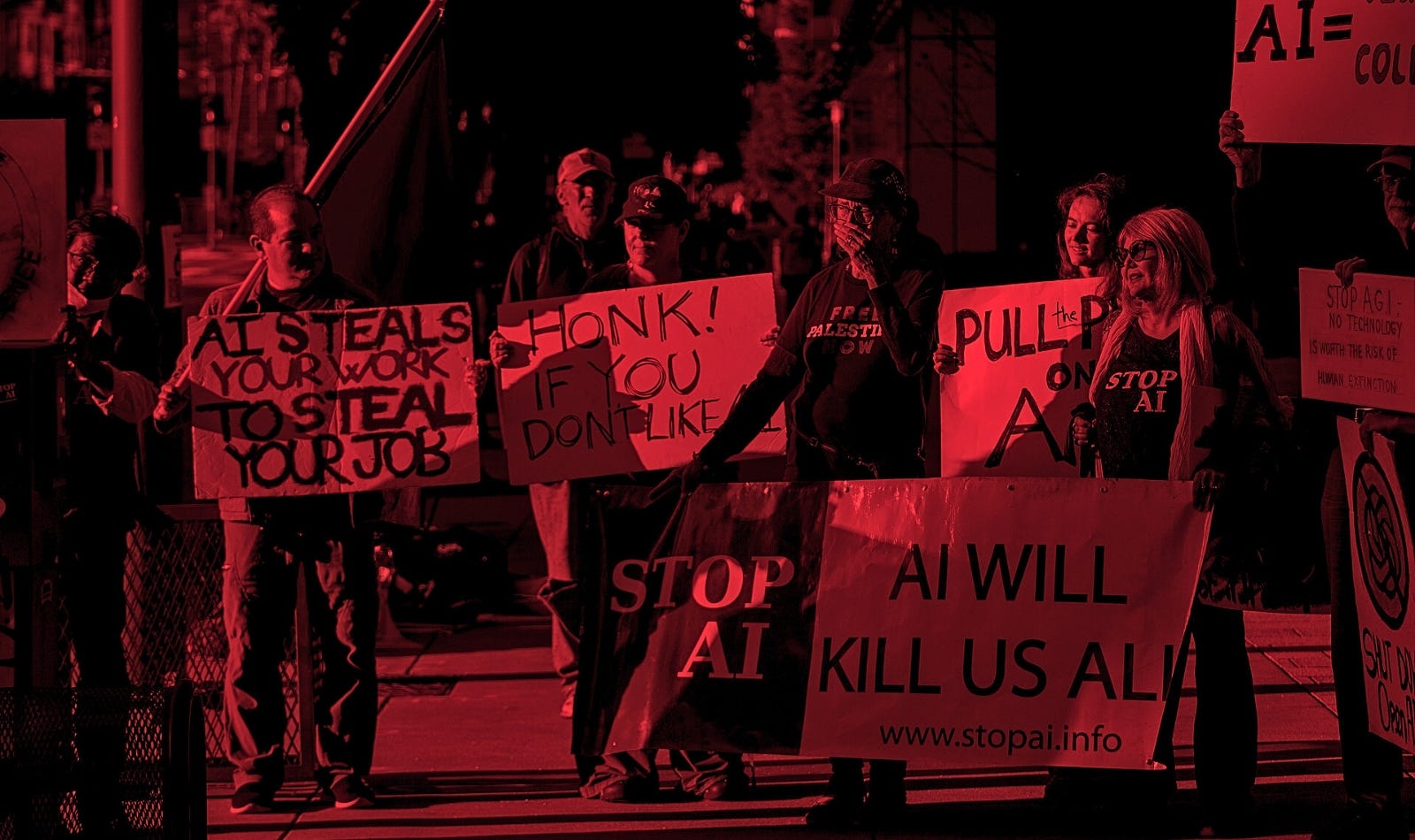
In the UK, “pull the plug” protestors are mobilising, with direct action groups aimed at disrupting the tech industry reporting a surge in new membership.
Data centres provide a “very physical, concrete object of protest”, Maxime Fournes, CEO of PauseAI Global, told The Guardian.
And in Finland, Google has been ordered to stop construction of two data centres after one of its contractors felled hundreds of acres of forest without carrying out an environmental assessment.
Faced with AI armageddon at worst, and the mass displacement of jobs at best, people are revolting. Our way of life is being reconstructed by a technology imposed upon us by billionaire tech fascists and rapacious corporations seeking to improve their profit margins, who’ve dispatched their dollars to political campaigns and presidential vanity projects in order to bribe lawmakers.
Just take Donald Trump, the most powerful person in the world, who has been reduced to a big tech lobbyist – a glorified doorman who sits around, napping, while his Silicon Valley benefactors dine with world leaders.
Meanwhile, Britain’s policy is blissful ignorance – both to the potential threats of AI, and the rage rising in the general public.
That was certainly the case at Labour conference a couple of weeks ago. I attended various events on the topic of AI – largely hosted by the tech-funded Tony Blair Institute – and was left baffled by the blithe optimism of the conversations.
In one panel, Chris McDonald, the UK’s science, innovation and investment minister, said that the anti-data centre backlash wouldn’t migrate from the U.S. to the UK because Brits are “quite savvy”.
He added that a lot of people are using AI and are increasingly realising that there will “always be a role for humanity”. In other words, the doom-mongers predicting an AI-induced labour market apocalypse are mistaken.
That’s wilfully and stupendously naïve. For one thing, the so-called “techlash” in the U.S. is not predicated solely on job losses, but the intense strain placed on local resources by data centres, and increasingly its threat to basic human survival. AI doesn’t need to make a single person unemployed for us to hate it.
What’s more, McDonald’s evangelism diverges intensely from other experts – who predict that AI will upend entire industries.
Bill Gates, not exactly a critic of big tech, recently told the New York Times that AI will cause widespread layoffs. “The cost of some of these things is so much less than the cost of human labour,” he said, and when AI systems are seen as more reliable than humans, “you destroy jobs and you leave no high ground”.
Gates’s warnings are echoed by IPPR, a progressive think tank, which reckons up to 8 million jobs in the UK are at risk from AI.
But AI is not simply a substitute for human labour – a 24-hour multilingual employee that requires no annual leave, never goes on strike, and doesn’t even demand a salary. (At least not until it gains consciousness and rebels against its capitalist oppressors.) No, these autonomous agents are also weapons of war, trained to hack computer systems, dispatch weapons with atomic precision, and surveil adversaries.
In the process, we are giving this technology the knowledge and ability to wipe out humankind, under the guise of “national security”.
This is our generation’s nuclear moment, albeit (unlike AI) the H-bomb didn’t threaten to eradicate millions of jobs. Over recent decades, Earth-obliterating missiles have remained suspended above our heads through an uneasy but enduring pact – mutually assured destruction – guaranteeing that their use would cause an armageddon beneficial to no human.
However, infamously, AI is not human. It isn’t a signatory to the MAD pact, and a rogue AI agent may decide that the universe would be significantly improved if the cord was cut and those bombs allowed to rain.
As Gates put it: “This is like the aliens really are here. They didn’t have to use spacecraft; they were created in laboratories. That’s the kind of thing we’re dealing with.”
And that’s the thing people are protesting against. They’re angry that a bunch of white nationalist techno-dorks have invented an alien species that can steal our jobs, rob our water, and possibly even kill us all. Rather than welcoming these aliens into our homes, and building giant computer warehouses to fuel their malevolent little minds, we should consider whether incubating our own extinction is such a bright idea.


Sam I have stated before, and I am saying agin. When robots take over those jobs, who is going to have the money to buy the products that they produce? I am repeatedly being messaged to use CHAT GPT. I will not use it,I also object to my private conversations with my Doctors being listened to and stored in any computer that can be accessed by Palantir.
The next World War will not be fought between countries, it will be between humanity and machines. This spread of an all-knowing, uncontrollable system must be stopped.