

📝 Sam Bright
It’s fascinating – and terrifying – the way in which the international far-right is reshaping local British culture and politics.
MAGA talking points are spewed out on social media platforms owned by Trump’s donors, amplified by the likes of Tommy Robinson – himself funded by a U.S. tech billionaire – resulting in flags being painted outside asylum hotels in otherwise isolated corners of the UK.
As a result, imported narratives and conspiracy theories do not simply echo online; they are reshaping how communities perceive themselves and their neighbours, turning British towns into battlegrounds in a culture war invented by American propagandists.
In this new guest essay, Kent-based journalist Joseph S. Furey explores how these forces have manifested in his local area, which is on the frontline of the confected “small boats” crisis.
If you enjoy this essay and want to see more great writers featured on this Substack, please sign up for a paid subscription...
📝 Joseph S. Furey
History teaches us it can happen anywhere. An ordinary backdrop can easily become a setting of consequence – its ordinariness soon forgotten in the glare of the spotlight. Faversham, in East Kent, is the latest place to find itself blinking in that glare.
The small market town has succumbed to a virulent strain of the nationwide “Raise the Colours” campaign. The flags on lampposts, St George’s crosses painted on any viable surface, the picketing of migrant centres, and the doxxing of opponents on social media, show no sign of abating.
Kent has staged its share of anti-immigration protests this year – in Dover, Folkestone, Canterbury and “Planet Thanet” (Margate, Ramsgate, Broadstairs) – but few expected them to spread to Faversham.
Named in The Domesday Book as a royal holding, the town is keen to project a genteel air: timber-framed and Georgian architecture, a scatter of independent shops, a working wharf, and Britain’s oldest brewery – hop festival and all.
So what’s got it so rattled? The answer: Acacia Court, in Ospringe, opened last year to house 32 asylum-seeking teenagers.
Since then, rumours have abounded: the youths are only posing as minors, they are dangerous to locals, and a threat to “real” children – as if the centre were incubating a grooming gang. A handful of agitators have hung outside the gates, filming the asylum seekers, heckling them and posting the clips online to “prove” their narrative.
Faversham’s largely Liberal Democrat town council has pushed back, pledging to defend community cohesion against xenophobic scapegoating.
Nigel Farage’s Reform UK, buoyed by its recent breakthroughs – most notably its capture of Kent County Council – has given the “concerned citizens” a carefully hedged nod of approval.
These are only the latest scribblings in a much longer saga. The Garden of England has always had a siege mentality. At its narrowest, the English Channel is just 18 miles across. On a clear day you can read France like a tabloid headline.
With its Saxon forts, Martello towers, gun pits, anti-aircraft batteries, sound mirrors, observation posts, plotting rooms and tunnels, Kent still carries itself like a county on a war footing.
And it sounds like one, too. In May I went to Ramsgate’s Royal Harbour to see 65 of the original Little Ships set sail for Dunkirk on the 85th anniversary of Operation Dynamo. The talk should have been of sacrifice – the risks taken by our forefathers to resist fascism. Instead, it turned – as if on cue – to the small boats: “Sink a few of ’em while you’re there, lads,” I overheard.
They glanced at me to gauge my reaction, looking away at the sight of my friend Diyar, an Iraqi Kurd, whose fine features, bronze skin and black hair they filed under “does not belong”. Diyar fled Kirkuk in 2015 with his daughter, spent months in the vast Idomeni camp on the Greek–Macedonian border and finally came ashore near Lydd a year later.
He was smiling. “It’s always the same. People here are mad about war – especially the ones who’ve never been in one,” he said to me. “They talk about the Battle of Britain as if they’ve just won it themselves.”
“Stop the boats,” people cry from clifftops across the country. In practice, only Kent – and to a much lesser extent east Sussex – receives them.
The uptick began in late 2018; before then, sea crossings were rare compared with stowaways in lorries and ferries. Brexit took Britain out of the EU’s Dublin returns system, making swift transfers far harder and helping to entrench the small boats route. Meanwhile, the boats themselves grew larger, more crowded and more perilous – driving up arrival numbers even as the total number of vessels fell.
So far this year around 34,000 migrants have reached the UK by small boat (as of 1 October). The record is 45,774, set in 2022. Almost all are taken to the Manston processing centre in Thanet. Designed for between 1,000 and 1,600 people for no more than 24 hours, by autumn 2022 it was crammed with over 4,000, some held as long as 33 days amid outbreaks of diphtheria, scabies and other Victorian illnesses.
Once screened and their claims logged, arrivals are pushed into the under-resourced Home Office pipeline – many bussed into government accommodation while their asylum applications grind through the system.
Despite Reform’s rhetoric around “luxury handouts”, the reality is meagre: £9 a week if meals are provided, or about £47 if they must cook for themselves – little more than £6 a day to cover food, clothing, toiletries, travel, and phone credit.
They are barred from mainstream benefits and most cannot work until a year has passed, and then only in a narrow band of shortage-list jobs. Some claims succeed, others are refused or appealed, and some end in removal. All live for years in a state of limbo.
The flag is a front, waved by people who swear they only want to feel “seen”. It has plausible deniability stitched into it.
But the reality is more sinister.
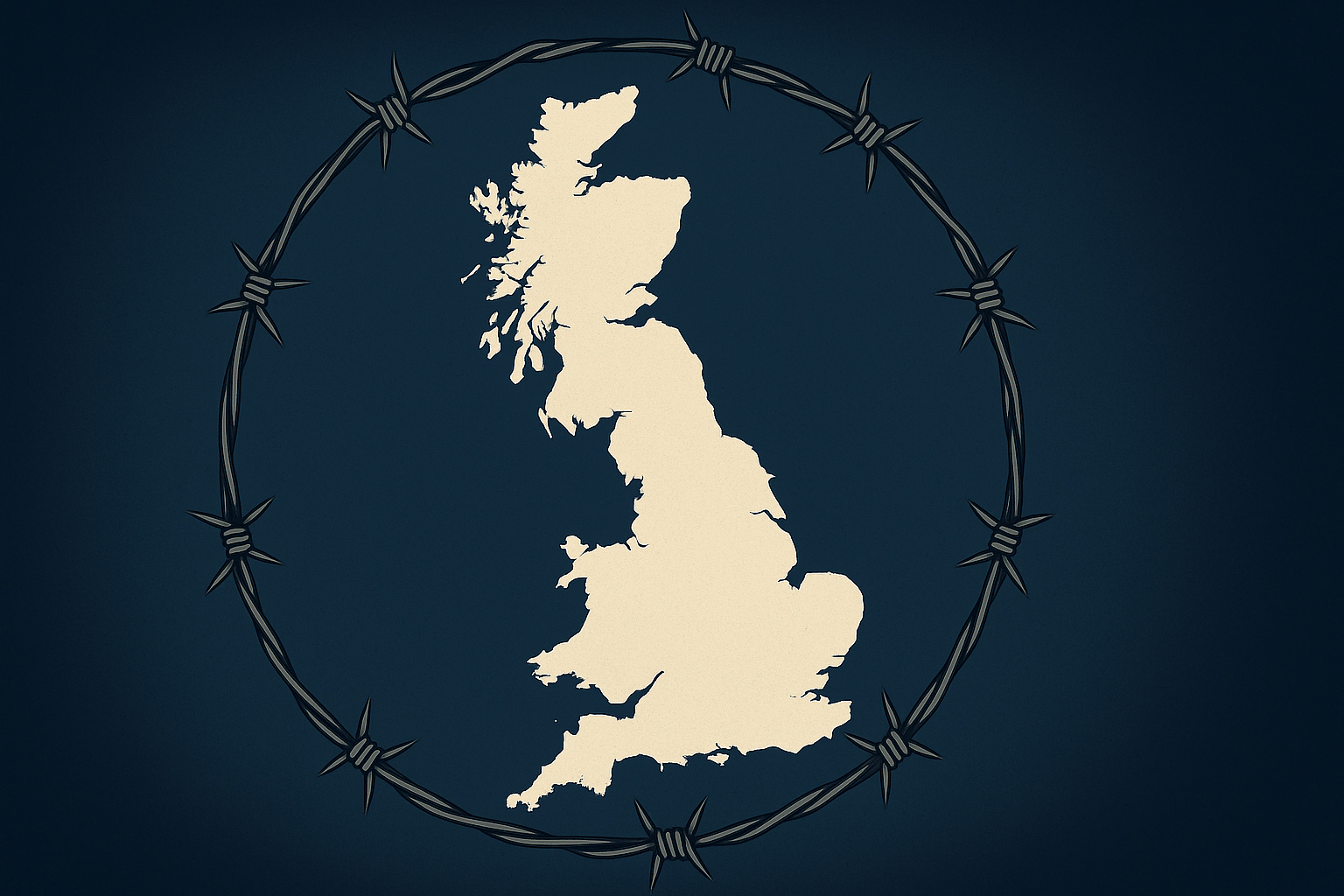
Make no mistake: Raise the Colours and Unite the Kingdom, which drew more than 100,000 protesters to London last month, want the same thing: nativist dominance; a fortress Britain built on exclusion.
It poses as spontaneous grassroots patriotism, but scratch its surface and you’ll find that veteran far-right and neo-fascist organisers are behind its coordination and financing. I don’t believe everyone marching beneath these flags is a conscious racist, but what is the appeal of standing with those who are?
The Unite the Kingdom rally, fronted by Stephen Yaxley-Lennon (aka Tommy Robinson), showed the far-right for what it has become: a global franchise.
Elon Musk appeared by video to call for the “dissolution of Parliament” and predict “violence is coming”, while the line-up ran from Ben Habib of Advance UK to Germany’s Petr Bystron (AfD), Denmark’s Morten Messerschmidt, Poland’s Dominik Tarczyński, Belgium’s Filip Dewinter, and even New Zealand pastor Brian Tamaki.
Having worked undercover in far-right enclaves across the United States – Coeur d’Alene, Idaho; Pocahontas County, West Virginia; Harrison, Arkansas – I know what radicalisation looks like. So to spot the same cues in the UK was chilling: recycled memes used to create crass merch, red caps everywhere, Charlie Kirk on t-shirts. Branding is belonging, I guess.
Even the talking points were imports: the great replacement theory; the plandemic; weather manipulation; anti-vaccine paranoia; child-trafficking cabals. They now come as a bundle. Pokémon rules apply – you’ve got to believe them all.
It feels less like politics than panic – not a routine surge of populist resentment but a collective delirium, orchestrated by opportunists who know how to monetise grievance on an international scale. People think they are acting freely, but this is exactly how mass hysteria works: movements are spread by imitation rather than conviction.
Fanned by social media, the danger lies not only in the ideas but in the speed and scale of their transmission. No one is safe when fake news cultivated by billionaire-backed Trump influencers can reach you anywhere within a couple of swipes – even in sleepy Faversham.
Where’s the hope? There’s plenty. For every attack on a migrant hotel in Kent, there’s been a louder show of solidarity. Faversham is resisting in impressive numbers. The recent UKIP protest in Margate was a sorry spectacle.
And, as Farage’s career shows, the British far-right cannot hold power for long. With no guardrails – no institutions, no discipline, only cults of personality – infighting is inevitable. Hate is a volatile fuel, quick to ignite and quicker to burn out. Politics that lasts requires patience and compromise, and hate has no talent for either.
And now the nights are closing in, I wonder how much appetite for anger will remain once the season demands blankets, not banners – though I’ve no doubt The Mail will try to keep the flames alive with its annual “Christmas is cancelled” refrain.
📣 If you’d like to see more pieces from Joseph and other great writers on this page, please consider taking out a paid subscription…
Joseph S. Furey is a freelance journalist who has written for The Times, Sunday Times, The Telegraph, and The Independent. He currently resides in Ramsgate, Kent, and raised his daughters in the county.

As a Folkestonian, I read this piece with all too much recognition. I am heartened though that the far right don’t represent the majority of our town. It pains me to see just how many are taken in though. Radicalisation seems so easy to achieve. Thank you for sharing.
Great piece. I wonder if we should consider social media like a toxin, as that is what it seems to be: destabilising governments and societies across the world. If we do think of it like that, and treat it as such, maybe we can find a cure.