
The influencer-politician problem
The old rules are dead.

I scroll through Instagram and see a quintessential English scene. A river meanders in the distance flanked by gentle green hills. White clouds etched with grey drift overhead. Rousing, orchestral music plays in the background, while a middle-aged white man talks about forcibly incarcerating and deporting millions of people to foreign shores.
I have to say, the benign scenery was a bit jarring alongside the fascist politics, but apparently this genre of video appeals to the millions of people signed up to the social media accounts of Rupert Lowe, the one-time Reform MP who now leads its far-right rival, Restore Britain.
Having emerged from relative political obscurity, Lowe now has a huge online audience. His reach extends far beyond X (formerly known as Twitter), the far-right breeding ground owned by sociopathic billionaire Elon Musk – a vocal Lowe supporter. The Restore Britain leader has 1.2 million followers on Facebook – twice as many as Keir Starmer – and 500,000 on Instagram, making him one of the country’s most popular politicians on social media.
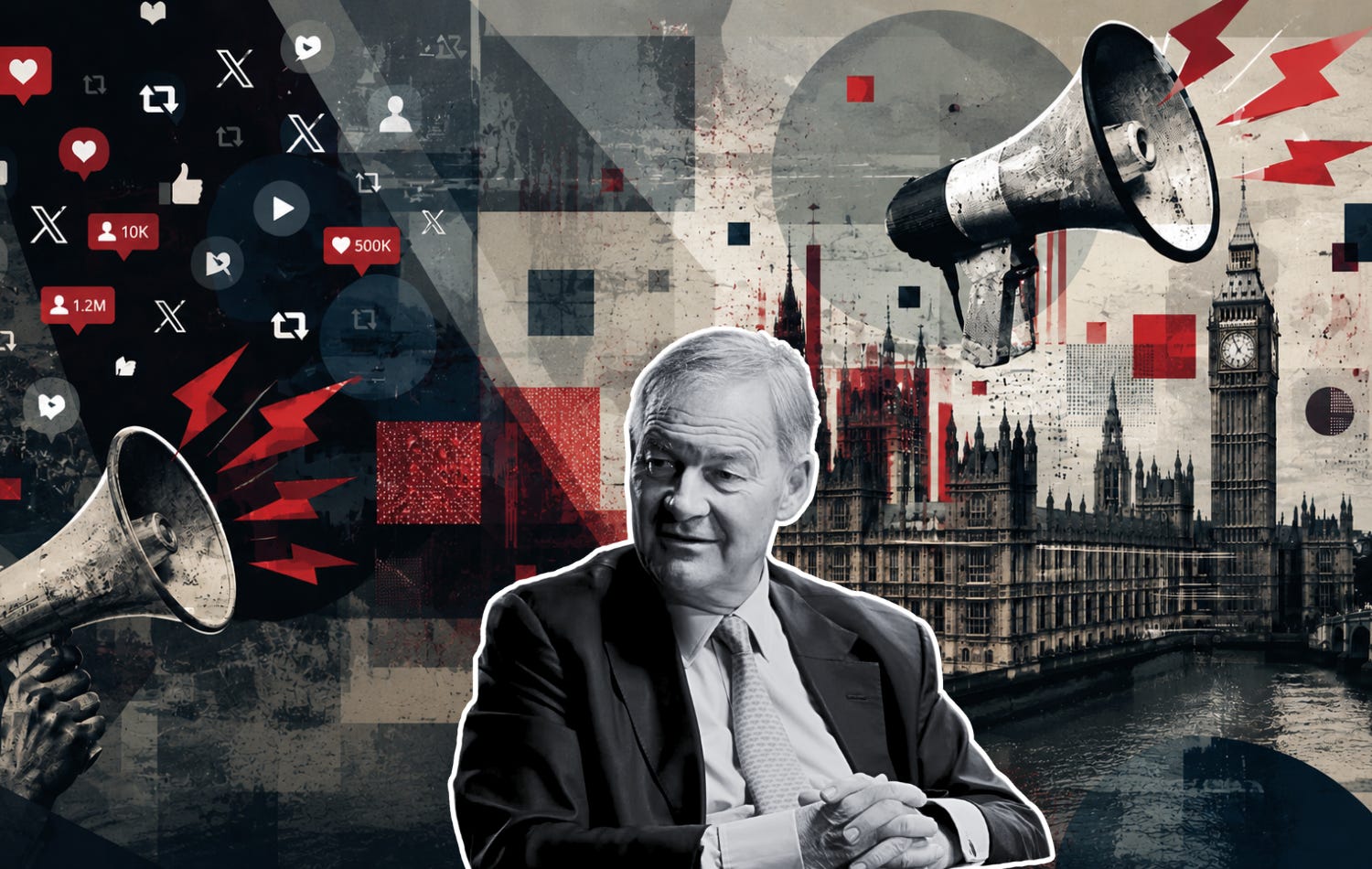
Lowe is the extreme right-wing manifestation of a trend that is upending politics across the West: the emergence of influencer politicians, whose support derives not from a long track record of public service, fealty to a political party, or mastery of the House of Commons – but viral online fame.
Our politics has become volatile enough to create influencer politicians – and influencer politicians in turn are making it even more volatile. They require virtually no infrastructure, beyond a camera and a few social media gurus, to influence public debate. They can spring up spontaneously and dominate the digital airwaves – saturating our social media feeds, the prism through which most people now consume their news.
Restore Britain has no real-world presence, yet its online footprint is vast and its electoral impact is tangible. Lowe is eating a decent chunk of Reform’s vote in the likes of Makerfield – potentially saddling Farage’s party with another by-election loss.
This isn’t a paywall.
A lot of writers would make you pay to read beyond this point, but I believe these facts should be seen by as many people as possible.
Lowe and his ilk have mastered a form of propaganda politics in which candidates can build personal brands and mobilise support without mediation – or scrutiny – from the press. If they can master the algorithm, they can attract adulation without the inconvenience of a reporter asking them how, exactly, they intend to keep an ageing economy afloat while shipping millions of working-age adults to their alleged “homelands”.
Influencer politicians are not exclusively right-wing. Zohran Mamdani and Zack Polanski have exploded on social media in recent months – algorithmically-inducing fanatical online followings.
However, this form of politics is particularly problematic when marshalled by reactionary politicians, who face a lack of scrutiny even at the best of times.
When it suits him, Nigel Farage can operate in the ideologically-enclosed echo chamber of GB News, The Telegraph, and his social media platforms, all of which are virtually free from countervailing opinions.
Indeed, he has been doing exactly that in recent months. Until Wednesday, Reform – which isn’t shy of thrusting its opinions at journalists – hadn’t held a press conference in 50 days. Even then, it put up Reform deputy leader Richard Tice, rather than Farage.
Separately, with only an hour’s notice, the party announced on social media that Farage would be appearing in Makerfield alongside its candidate Robert Kenyon to announce policies supporting “white van man”. Yet, only select media organisations were allowed to attend, and even fewer permitted to ask questions. The Guardian was not invited to the press conference and was told on arrival that, even if its journalists hung around, they would not be given the chance to interrogate Farage.
When you can distribute your message to millions of people unfiltered through social media, you can treat journalists with disdain – and especially journalists who ask the most uncomfortable questions.
In turn, this has reshaped the media. Many outlets have realised that the only way of maintaining access to politicians (who may help to send their content viral) is by treating them with the same blind, unquestioning devotion that they receive online. Publications that used to conduct decent, investigative reporting (i.e. The Telegraph) have therefore been refashioned as paywalled propaganda pamphlets.
Subscribe to proper, investigative reporting that speaks truth to power…
This is different to how influencer politicians on the left are treated. Polanski is still ferociously (and often unfairly) scrutinised by the press, despite having risen to prominence in a leftie echo chamber. While he has millions of online cheerleaders, there are no sizeable progressive publications that act as the vanguard for Polanski’s politics in the same way that GB News, The Telegraph, The Express and the Daily Mail go to war for Farage every day.
However, I’m sad to say that even Polanski and his movement exhibit some of the negative features of influencer politics.
There’s a heavy dose of naïvety among Zack’s super-fans, who have only been exposed to the carefully calibrated version of him presented online.
For example, as someone with eye-watering levels of student loan debt, I can’t help but wonder: how come Zack the Revolutionary stood for a pro-austerity party, the Clegg-era Liberal Democrats, when they were in league with the Conservatives? And why does he receive unrepentant adulation from the same people who protested in the streets against the coalition government?
As noted in this interesting profile, Polanski also exhibits a certain crankiness, a short-tempered streak, that is common among politicians who are adored online (a trait that is eerily reminiscent of the chronically tetchy Jeremy Corbyn).
I worry that our reliance on social media to incubate leaders of the future – including on the left – will inevitably favour those opposed to fact-based politics. Short-form content platforms and their socially manipulative algorithms favour the sensational, radical, and simplistic – none of which help the pursuit of reality (after all, the truth is often highly complex).
Granted, it’s impossible to survive in modern politics without being mildly proficient at social media – and Starmer’s digital naïvety is one of his great deficiencies (among many). But progressive politicians must see social media as a means to an end. If they’re swallowed by social media, they’ll lose their moral core.
What’s more – and much worse – making social media the training school of modern politics risks giving a megaphone to fascists and racists who are able to preach their gospel of hate to millions without interruption.
In normal times, Rupert Lowe would be a fringe loon – shouting loudly into the void.
But, in an era without gatekeepers – when anyone with a Barbour jacket and an ethno-nationalist grievance can become an influencer – our politics is less predictable and less stable than ever.
Buckle up, because I don’t think we’ve seen anything yet.
About me
I investigate the rich, populist and powerful – focused on Nigel Farage and his cronies. I’ve written for the likes of the New York Times, The Guardian, and New Statesman, have worked with Led By Donkeys, and have written two books on elitism and inequality.
Great piece. This is the contemporary politician's challenge - which Trump has shown the way. You need to work social media in a dynamic way. You would expect the main parties to be all over this - but they are way off the mark. We don't see the #PM engaging with mainstream media, nevermind social media - who does he think he is speak to?
Would Starmer be as hopeless on social media as his dull platitudinous speeches are in the Commons?
Perhaps, stripped of the ponderous adenoidal timbre of his audio delivery and confined to fewer words, some brisk delivery on X would be a good exercise in comms for Starmer.
Were it not that the UK government should right now be removing itself entirely from X and from patronage of and by its poisonous, racial hatred and riot-inciting trillionaire owner.