
What Labour and the BBC have in common
They still don’t get it...

There’s a strange symmetry between the Labour Party and the BBC at the moment. Namely, both are behaving with intense, self-destructive naivety towards the right-wing press.
They are trying to placate a media empire that has long abandoned any credible commitment to journalism and now operates as a culture war machine. And the past two weeks have revealed just how deeply and profoundly this naivety runs.
Labour and the BBC still act as if The Telegraph, GB News and their allies are operating in the old mode of journalism – as rational actors with a tangible if somewhat hazy belief in truth as the core function of journalism.
That era is gone. Long gone.
Right-wing outlets have increasingly become political actors in their own right, pursuing ideological outcomes rather than following the evidence.
GB News is a political body, a campaign group for ugly nativist politics, not a news broadcaster. It even has its own politicians – Nigel Farage testified before Congress earlier this year wearing a GB News lapel badge (perhaps because it’s by far his biggest source of income).
You can even see this transformation in their marketing material. The Telegraph’s adverts don’t promise honest reporting or groundbreaking investigations; they promise that the paper will “uphold the values that matter to our readers”.
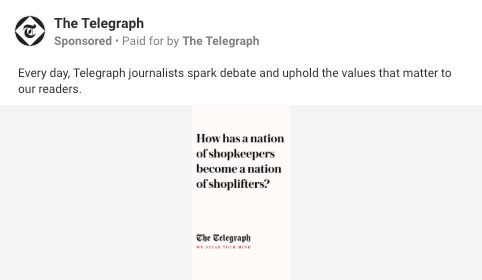
(Also “spark debate” seems like a euphemism for writing stuff that is controversial and inaccurate. After all, that happens to be The Telegraph’s forté.)
This is an admission that truth is no longer important to The Telegraph. Instead, it wants to mould its readers into an ideological template and use its front pages as a weapon to bully and harass anyone who doesn’t agree with its radical worldview. And the rest of the right-wing media is cut from the same cloth.
Labour and the BBC don’t understand their enemy – or even know that their enemy exists. They’re running around with bayonets while their adversaries are dropping nukes.
Labour’s anti-asylum package announced this week is a case study in this errant blindness.
Keir Starmer is acting as though it’s still 1997, when the press broadly played by the rules. New Labour’s policy of “triangulation” (finding a mid-point that placated both sides of an argument) worked in this era, because the right still held some relatively sane opinions.
In 2025, the right has plunged so far towards feral ethno-nationalism that even a middle-ground approach puts you somewhere to the right of Enoch Powell. That’s pretty much what has happened with Labour’s asylum policies.
Triangulation is also a fool’s errand because the right-wing press no longer respects the truth. Starmer in his sweet but suicidal naivety seems to think that he’ll be exalted by the Daily Mail if he fixes the asylum “problem”.
He’s wrong. He’ll never win the argument, because ultimately he’s trying to fight a ghost – he’s trying to solve a problem that doesn’t really exist.
The asylum “issue” in the UK – such as it is portrayed by every major news outlet – has been contrived by Farage, GB News, The Telegraph, and the far-right.
Yes, there is something quite obviously sad and worrying about thousands of people risking their lives to bob across the Channel in dinghies, only to wait in a state of purgatory for years while their asylum claims are processed.
But is this the biggest issue facing modern Britain – with its NHS backlog, collapsing infrastructure, chronic housing crisis, and ever-soaring household bills? Not a chance.
Let’s say for the sake of argument that Starmer’s policies are “successful” (say in reducing the number of UK asylum applications). Does he think the press will simply sit back and applaud him?
I can’t see it. They’ll just invent a new bogeyman – a new epidemic – that he’s to blame for, and will demand a fresh round of appeasement.
Starmer appears convinced that if Labour can just demonstrate enough administrative competence, the right-wing press will begrudgingly concede the point and move on.
He’s acting too much like a lawyer. He thinks the court of public opinion is equivalent to a judge or a jury – fair, rational, willing and indeed obliged to absorb all the relevant evidence. This forlorn belief means that he’s subjecting himself to a Kangaroo court led by Paul Marshall, Rupert Murdoch and Lord Rothermere.
It’s as if Labour’s immune system has totally failed. It’s no longer capable of realising when a hostile body has entered its bloodstream.
Take the story we reported at DeSmog this week. Influential Labour peer Maurice Glasman – fresh from advising Starmer’s chief of staff Morgan McSweeney – spent his Sunday speaking at the annual conference of a pro-Reform group that has spent years aggressively attacking Labour and stirring up baseless conspiracy theories about its allies.
Glasman may have thought he was engaging constructively in an open, good faith debate. In practice, he was legitimising an organisation fundamentally hostile to his own party. He assumed goodwill where there is none.

The BBC is in the same boat – sailing off into oblivion thanks to a strong right-wing tailwind.
For years, our public broadcaster has internalised the idea pushed by The Telegraph, The Mail and their broadcast cousins that it’s a hive of left-wing bias.
Instead of challenging the absurdity of this claim, the BBC has repeatedly adjusted its output to demonstrate “balance”, often by amplifying perspectives and frames that originate in the same outlets determined to undermine it.
But the problem runs deeper than the BBC’s fear of criticism. The corporation still moulds much of its political agenda around the priorities of the print press. The daily paper review remains a staple of its output, and the editorial assumptions of the major newspapers heavily shape what is treated as significant or urgent.
Since the papers are overwhelmingly right-leaning – and in several cases have drifted firmly to the far-right – the BBC ends up reproducing their worldview whether it intends to or not. It absorbs their obsessions and anxieties, then launders them through the veneer of impartiality.
The result is an organisation that appears permanently on edge, nervously reshaping itself to meet the expectations of critics who do not want the BBC to be fair and neutral, but consigned to the dustbin of history. Tim Davie’s resignation as director-general is simply the latest consequence of an institution trying to negotiate with actors who want it dead.
Labour and the BBC, despite their enormous influence and their deep (though ever-diminishing) reservoirs of public trust, are united by a fatal misreading of the era they inhabit. Both seem convinced that, if they can merely placate their opponents in the right way, their good intentions will be rewarded.
But this fatally misunderstands the nature of the opposition. Right-wing media outlets are not trying to improve public institutions; they are trying to pulverise them.
And yet both Labour and the BBC continue to behave as though there is some equilibrium to be reached that will neutralise the hostility. In reality, the more they compromise, the more they validate the narrative that they have something to atone for.
The right has changed fundamentally. Until Labour and the BBC grasp that they are dealing not with journalists but with political combatants, they will continue to make concessions that accelerate their own decline. They will remain trapped in the past – still following rules that their opponents torched years ago.
“One of our finest investigative journalists.”
– Peter Oborne
About me
I’m an investigative journalist and current affairs writer who has worked with the New York Times, the Guardian, the Mirror, the New European, Novara Media, New Statesman, Led By Donkeys, and others.
I specialise in exposing dark money and radical right-wing ecosystems.
I also write a lot about inequality and elitism, and am the author of two books on those very subjects: Fortress London, and Bullingdon Club Britain.
Why subscribe
Trump, Musk and Farage are on the march – followed closely by Badenoch and an increasingly radicalised Conservative Party. Investigative journalism exposing their funding sources, their plans, and their networks has never been more important.
Laser like analysis Sam. Brilliant.
Perfectly on point, operating on dated methodology and assumptions. Their lack of savvy is literally leaving the door open for right wing agendas